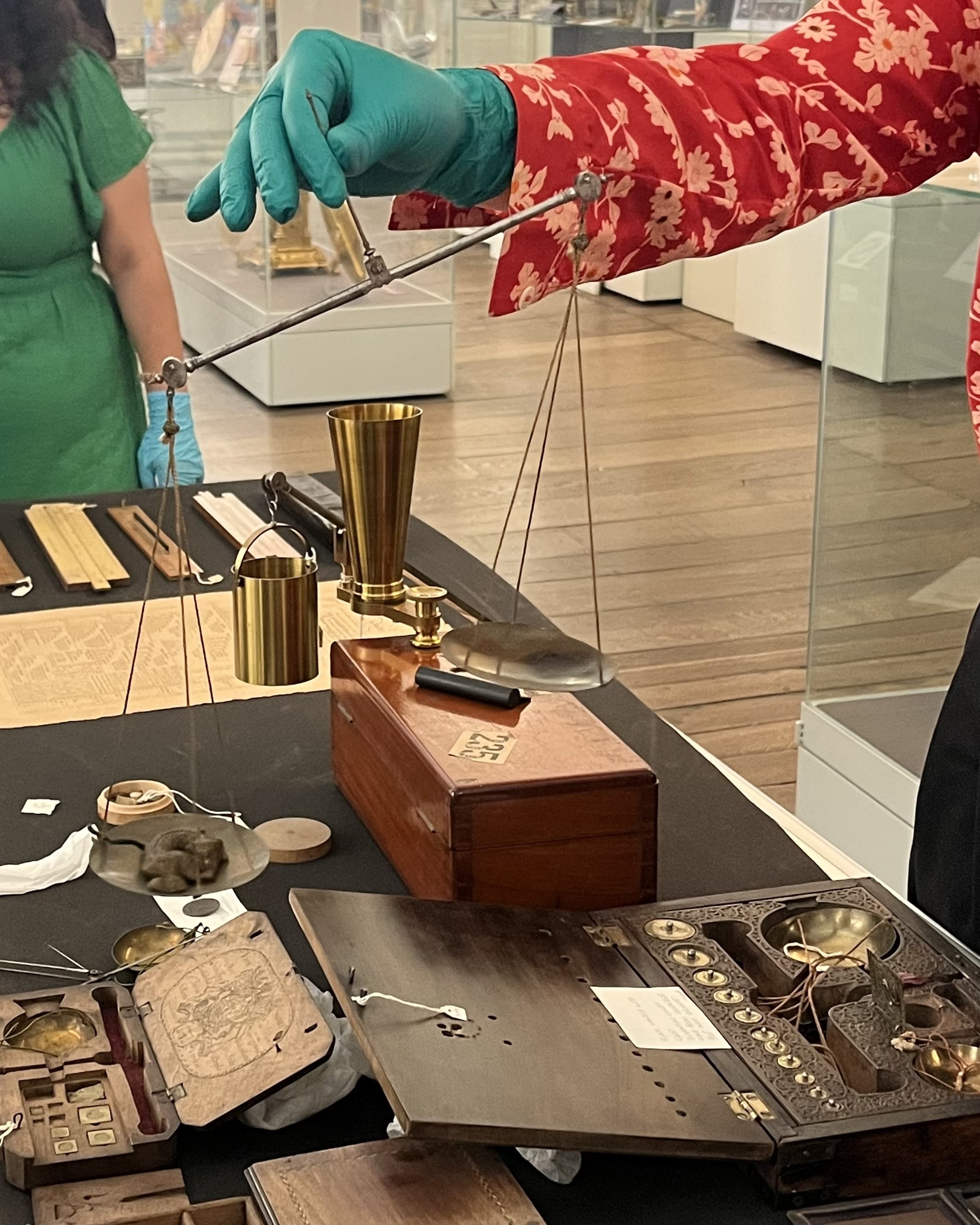
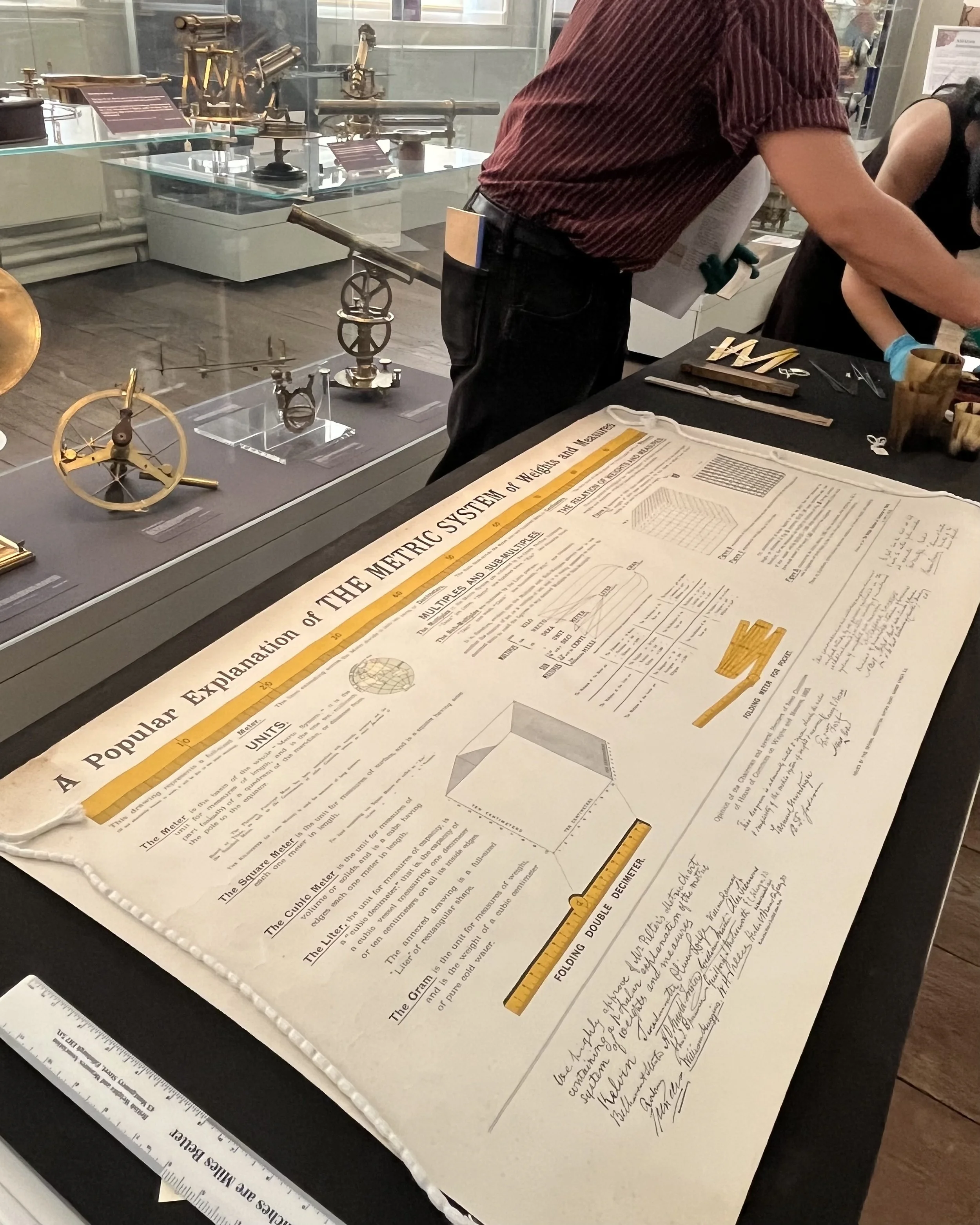
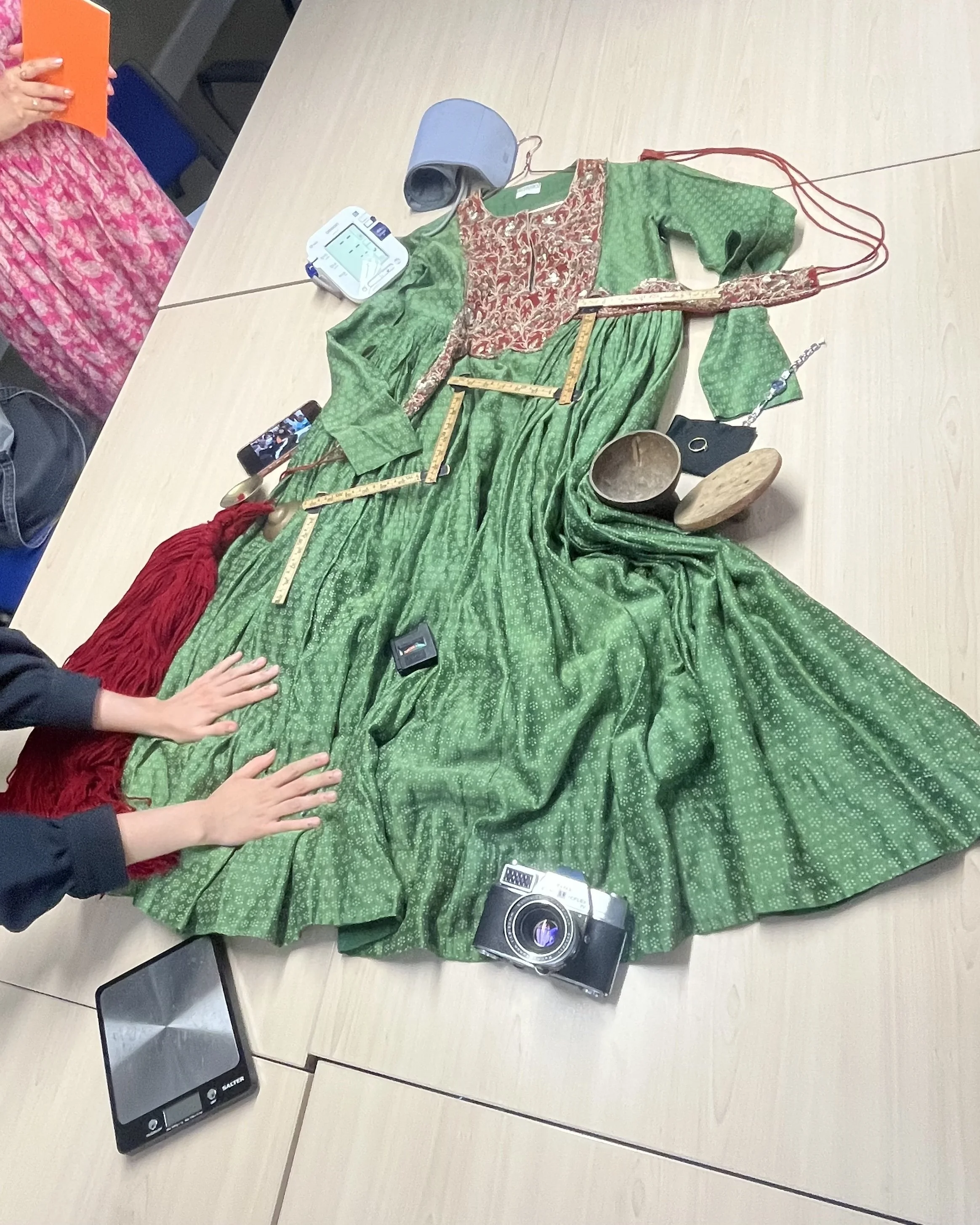
At the second Colonial Standards workshop, Tools and Measures of the Trade, we were invited to think with museum objects. The workshop encouraged us to see measurement and standardisation as social and political practices. What does it mean to measure land, trade, value, distance or accuracy? Who decides what counts as a correct measurement? And what is left out when museums organise knowledge through these categories?
One of the most valuable aspects of the workshop was the way participants collectively questioned museum interpretation. During a discussion about a coin linked to the East India Company or Zanzibar, participants began doing provenance research in real time. One person recognised the East India Company connection, another translated markings on the coin, while others questioned whether the date or attribution attached to the object was accurate. It was a small but powerful example of what can happen when interpretation is opened up. Expertise did not belong only to the museum or the object label.
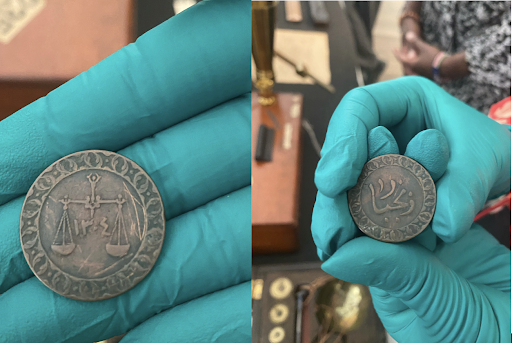
‘East India Company Coin Weight for Copper Half Pice, Bombay, 1791.’ HSM Inventory Number 15046.
The workshop helped me think more deeply about measurement itself. Measurement, usually understood as units and precision, is also tied to control. Its systems have never been neutral and have obscured other ways of knowing and valuing the world. Conversations during the workshop about counting on the creases of our fingers, measuring garments using handspans, estimating ingredients by eye while cooking and older South Asian systems such as the ratti (traditionally used to weigh gemstones) reminded me that measurement is also rooted in everyday practice and embodied knowledge. These forms of measurement may not appear in museum records or official archives, but they remain important ways of making sense of the world.
The workshop also made me think critically about the language of community participation. Projects like this often refer to “the community” as if it is a single, unified group. However, everyone in the room had different relationships to South Asia, Britain, museums and colonial histories. Community is not a monolith and participation alone cannot resolve existing inequalities.
There was also a visible hierarchy between the museum and participants, and between institutional research and lived experience. The project invited us to contribute to a Reference Guide to the Missing, an ambitious and generous idea. But co-authorship is complicated. Who decides what enters the guide? What forms of contribution are recognised as knowledge? Reflections, drawings, performances, emotions, silences and disagreements are all reactions. They, however, are not all equally easy to record within institutional outputs.
This is where I felt both the promise and the tension of the workshop most strongly. We were encouraged to explore alternative knowledge systems, while still largely working through museum and academic frameworks. A decolonial approach cannot simply add more voices to an existing structure; it must also question how that structure shapes what can be said, recorded, valued, and remembered.
For me, the workshop’s most meaningful moments were not ones of consensus but of uncertainty. When participants questioned ‘accuracy’, when a coin’s provenance became a collective investigation, and when participants asked what would happen after the project ended. These moments showed that measurement is not only about standards. It is also about power: who measures, who is measured, and what forms of knowledge become measurable.
Perhaps the Reference Guide to the Missing should not only document what is absent from museum labels, but also what is difficult to capture in museum records at all: uncertainty, disagreement, memory, and the feeling of encountering an object that both does and does not belong to you. These experiences remind us that standards are never purely technical.