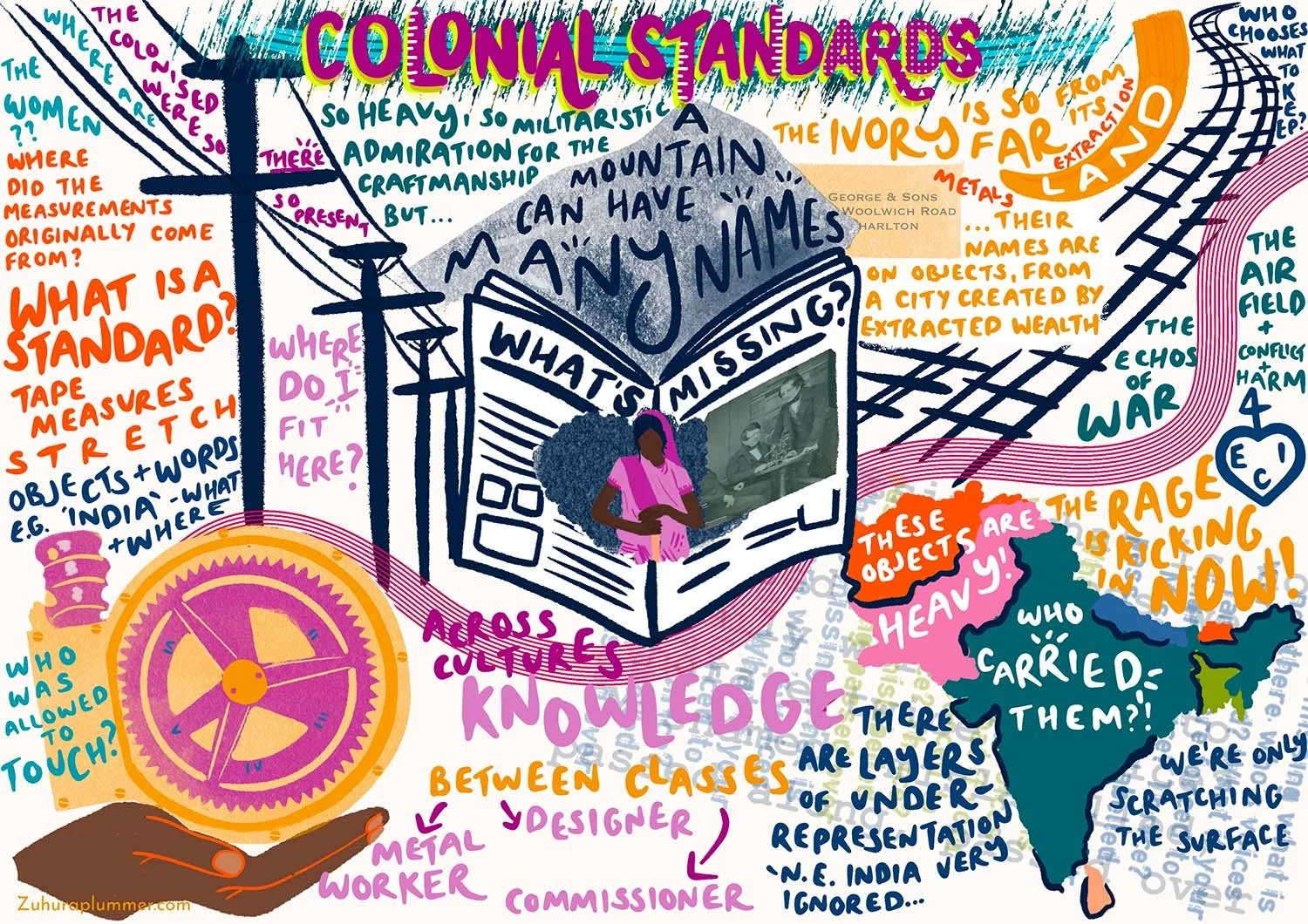
The community workshops of the Colonial Standards project seek to bring members of the South Asian diaspora community in conversation with the collections in the History of Science Museum. The workshops aim to address notions of authority, neutrality, and justice considered to be inherent in measuring objects and scientific instruments held in a museum devoted to the history of science. It also asks how the South Asian community can meaningfully shape the research agenda and inform the interpretation of museum objects related to the colonial history of South Asia, thus making these objects and histories more immediate and accessible to wider publics.
‘We questioned: who has access to knowledge, who gets to inform research on museum objects and how can we reclaim agency in the history of these objects? In order to address these questions we developed a series of workshops that invited members of South Asian communities to explore scientific instruments held in the museum’s collections. By recognising that participants are experts of their own knowledge, and that their lived and professional insights are essential to understanding the history of measurement, we aim to work collaboratively to build a community toolkit.’
‘Our primary goal is to shift the museum from being a ‘sole authority’ to a ‘collective authority’.’
– The New Cartographers
Our First Community Workshop held on February 16, 2026 at the History of Science Museum, Oxford and its off-site storage facility was on the theme of ‘Land Measures and map-making’. Community participant researchers handled objects related to the measurement of land, including theodolites, perambulators, a Gunter chain, cross-staff, plane tables, etc. There was a particular emphasis on objects connected to the Great Trigonometrical Survey of India and the East India Company officials who undertook this grand geodetic project in nineteenth century India. Participants engaged with questions of provenance, materiality, utility, and aesthetics of the objects. They questioned the social relationships and forms of power that were obscured in the museum’s presentation of these objects as scientific objects. They also asked how colonial knowledge of measuring and metrology related to local ways of knowing and measuring land or distance. You can read more about this first workshop in our booklet.