Moisture Meter: How the Green Revolution continues to shape the lives of paddy cultivators in South India
The popular story of the Green Revolution in India is often a valorisation of the ‘heroic’ efforts taken by diplomats, bureaucrats, and most importantly the agricultural scientists to prevent India, a newly independent developing country, from falling into famine at the brink of it. They saved the country by modernising agriculture, introducing high yielding varieties of wheat and paddy, chemical fertilizers and pesticides, and mechanisation of farm work. While there are several criticisms to these efforts - as to how it mostly benefitted the large landholders, how it failed to take into account the ecological impacts of chemical fertilizers and HYVs, how it failed to bring structural changes in rural Indian society such as the redistribution of land - both the critical and valorising narratives of the Green Revolution miss out the post-harvest processes. How did the cultivated paddy reach the plates of the people? How were the farmers compensated? How was the rice stored? How did the state ensure quality? What were the new institutions built to carry out these processes? How does it shape the lives of farmers today? An instrument of food grain quality, the moisture meter, offers us an entry point into the world of post-harvest, the history of state’s efforts to modernise post-harvest processes, and how the technocratic and institutional interventions made by the state continue to shape the present realities of farmers and cultivators.
A moisture meter is an instrument used to measure moisture content of food grains. The first time we encountered a moisture meter was in a field work that is completely unrelated to measuring instruments. It was during the month of October in 2023, in a small village in the deltaic region of the Kaveri river in Tamil Nadu, South India, where we had gone to document the impacts of a climate adaptation project in the region. The Kaveri delta region has a long history of paddy cultivation spanning over a millennium and is characteristic of intricate networks of rivers and canals irrigating vast areas of lush green paddy fields. In the 1960s, when new cultivation technologies were introduced in India with the intervention of Ford Foundation in the form of the Intensive Agriculture District Programme (IADP) in seven selected districts, Kaveri delta region was one among them. This programme later came to be known as the Green Revolution. It continues to be a major rice cultivating region. On an average about 12 lakh acres of land are cultivated with paddy currently, with agriculture being the major source of employment in the region.¹
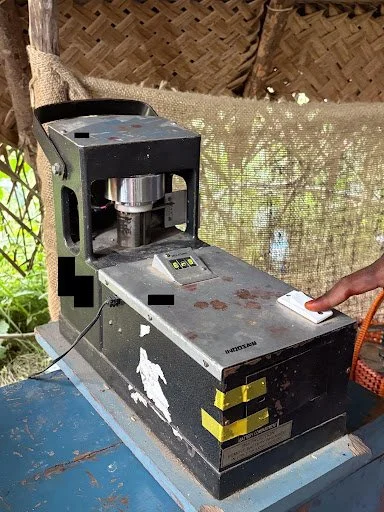
A present-day moisture meter used at a paddy procurement center in Kaveri delta. Photo: Shankar Nair.
On one of the days of October 2023, as we were talking to a group of farmers in a village named Irulneeki, everyone scattered away as the rain started to pour. They rushed to the paddy they had spread on the road to dry, and covered it with a tarpaulin sheet. After the rain had subsided and the farmers relaxed, we asked about what had happened. Farmers started to express their anxiety over the paddy getting wet, and that wet paddy would be rejected by the state procurers. They took us to the state-run procurement centre a few meters away from us. It was an open yard, which previously was the village’s common threshing floor, with a thatched shed to shelter paddy that is bought from the farmers. This thatch also acted as the office for employees who assess the quality of paddy, produce bills, and keep books. On a table on the bright side of the thatch was an unusual looking tool, the moisture meter. The employees and the farmers were enthusiastically explaining how the small digital screen should show a number below 17, when a cup of sample paddy pressed into the machine. Only then is that lot of paddy considered fit for procurement. If it exceeds 17 then they would need to be dried further. A farmer later sharply asked, ‘how would the paddy dry when it's monsoon for us?’ Which is true indeed, harvest and procurement of paddy do happen during the monsoon when the region receives most of its rainfall. This question asked by farmers expressing the contradiction they encounter in their everyday life, informs our current work on the instrument of moisture meter.
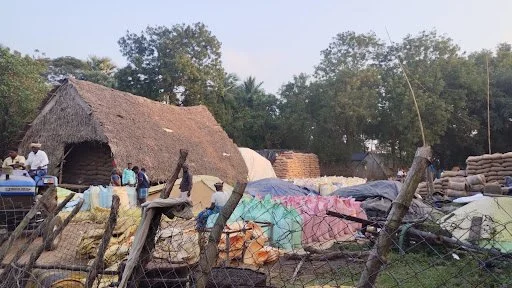
A Direct Procurement Centre in Nagapattinam District of Kaveri Delta. Photo: Author.
Along the lines of the farmer when we ask how the standard for quality of paddy is set, why it adds more burden on the shoulders of paddy cultivators, and how are certain experiences and procedures are ascribed with objectivity, it takes us to the various national laboratories where food scientists do the work of creating and reassessing standards and enforcing them in a technocratic manner. It also allows us to look at the power held by the union government over the quality standard, and the political struggle between the local state government’s demand for relaxation in moisture content and the union government’s systemic refusal to the demand. It also allows us to look at how this impacts the households of the paddy farmers, in terms of increased cost to dry paddy.
When we try to ask: how did the harvest of paddy come to coincide with the monsoon? Has it always been this way? We are taken to the times of the Green Revolution. Historically, most land in Kaveri delta was capable of cultivating only one season of paddy, owing to the lack of water all through the year in the Kaveri. Paddy was cultivated twice a year where there was access to water over a longer period. In order to increase productivity, new varieties of paddy crops were introduced in the 1960s that could mature faster. This allowed for cultivating two crops within the period when water was available. This came with a catch, as the harvest of the shorter cropping season coincided with the returning monsoon.
Cultivation of short duration crops continues till today, and every year the state pushes for expansion of short duration crop varieties in the delta region. The paddy variety that was pushed as the advanced short duration crop variety in 1967 was called ADT 27. The technocrats of the Ford Foundation did expect the coinciding of the harvest of this crop along with the monsoon. They also did worry about the paddy being wet and that it would get spoiled if it were not dried properly given that sun-drying paddy during monsoon was an impossibility. The Ford Foundation pushed the newly set up Food Corporation of India, the union government, and the state governments to fund the construction of regional paddy drying units, and constructed several such units across the delta to dry the wet paddy and move it to paddy deficit regions.² These dryers are not functional today, but one can see their remains. There are no such public drying centres in the delta today, and the burden of drying paddy rests with the farmer. When, why, and how this shift of burden of drying from the state to the farmer happened is something that needs to be further explored.
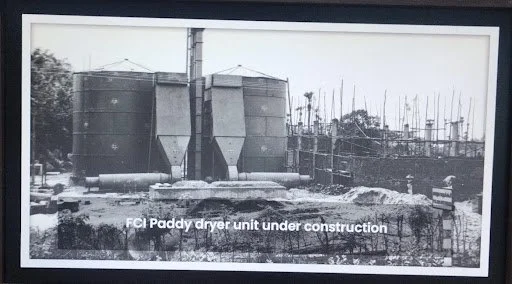
Photo of Paddy drying units under construction. Photo: Food Museum, Thanjavur.
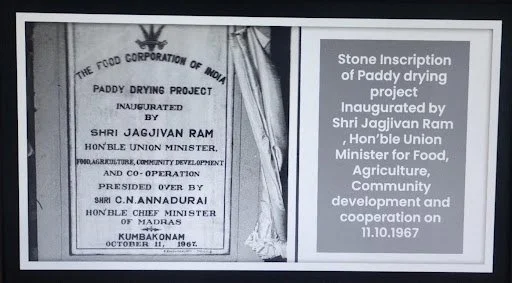
Stone plaque documenting inaguration of Paddy Drying Units in 1967. Photo: Food Museum, Thanjavur.
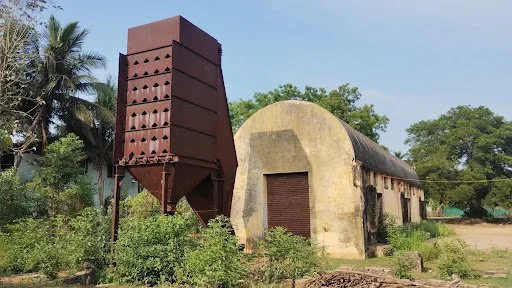
Paddy drying unit in a small town called Orathanadu in ruins. Photo: Author.
¹ Ramakrishnan, T. “Paddy Coverage in Cauvery Delta during Current Samba Season Lower than Last Year.” Tamil Nadu. The Hindu, October 5, 2025. https://www.thehindu.com/news/national/tamil-nadu/paddy-coverage-in-cauvery-delta-during-current-samba-season-lower-than-last-year/article70125611.ece
² Kramer, Fred A. “Paddy Dryers for Thanjavur: A Case of Agricultural Development in India.” Asian Survey 11, no. 8 (1971): 787–802. https://doi.org/10.2307/3024640.